

Why Florida’s 2026 tourist tax reform debate requires auditing the state’s baseline workbook
Florida operates the largest county-level transient lodging tax system in the United States, raising roughly $1.7 billion to $2.0 billion annually across 63 levying counties under Florida Statutes Section 125.0104 (Tourist Development Tax), Section 125.0108 (Tourist Impact Tax), and Section 212.0305 (Convention Development Tax). During the 2025 and 2026 legislative sessions, proposals such as HB 6031, HB 6007, and SB 458 have centered on whether counties should retain strict destination-marketing and beach-renourishment earmarks or gain broader authority to deploy bed-tax receipts toward property-tax relief, public infrastructure, and workforce housing.1
Legislators, county commissions, and municipal bond analysts routinely rely on the Florida Legislature’s Office of Economic and Demographic Research (EDR) workbook realizedtourism.xlsx as the authoritative 67-county baseline. To test both the integrity of that series and the historical demand response to county rate hikes, we extracted all 18 state fiscal years (SFY 2009–10 through SFY 2026–27; 1,206 county-year observations) from EDR’s September 2026 data release, cross-checked every county’s statutory rate against EDR’s LOTTrates.xlsx and LDSSrates.xlsx tables, and audited major county estimates against primary local comptroller and county budget reports.2
| County | True Local Rate | EDR Sheet Rate | EDR Est. Base | Audited / Budget Ref. | EDR Double-Count | Unrealized TDT | Audit Finding |
|---|---|---|---|---|---|---|---|
| Orange | 6% TDT | 6% TDT | $6.96B | $6.41B (FY25 $384.6M) | $0.00M | $0.00M | FY24-26 surged 2x to $14.0B |
| Miami-Dade | 3% TDT + 3% CDT | 6% TDT + 3% CDT | $0.91B | $4.17B (CDT $125.1M) | +$27.23M | $0.00M | -81.7% drop FY24 + 9% bug |
| Broward | 6% TDT | 6% TDT | $2.51B | Consistent series | $0.00M | $0.00M | Clean self-admin benchmark |
| Palm Beach | 6% TDT | 6% TDT | $1.74B | Sales cut 7%->6.5% '26 | $0.00M | $0.00M | 12.5% total eff. Jan 1, 2026 |
| Pinellas | 6% TDT | 6% TDT | $1.56B | Consistent series | $0.00M | $0.00M | Clean 13.0% combined stack |
| Monroe | 4% TDT + 1% Imp. | 5% (cap 7%) | $1.44B | 5% of 7% max | $0.00M | $28.73M | 39.7% of post-Nov headroom |
| Lee | 5% TDT | 5% (cap 6%) | $1.22B | 5% of 6% max | $0.00M | $12.20M | 1pp unused coastal capacity |
| Walton | 5% South / 3% N. | 5% (cap 6%) | $1.21B | Subcounty district | $0.00M | $12.07M | 1pp unused coastal capacity |
| Collier | 5% -> 6% Jan '27 | 5% (cap 6%) | $1.16B | Ord. 2025-33 (70.2%) | $0.00M | $11.59M | Approved Nov 3, 2026 vote |
| Bay | 5% TDT | 5% (cap 6%) | $0.81B | Tax Coll. Oct 1, 2026 | $0.00M | $8.11M | 1pp unused coastal capacity |
| Volusia | 3% TDT + 3% CDT | 6% TDT + 3% CDT | $0.57B | 6% combined local | +$16.95M | $0.00M | 9% double-count bug FY25-27 |
| Duval | 4% TDT + 2% CDT | 6% TDT + 2% CDT | $0.56B | 6% combined local | +$11.27M | $0.00M | 8% double-count bug FY25-27 |
Forensic finding 1: A $153.0 million three-year statutory formula double-count
Under Florida Statutes Section 125.0104(3)(b) and Section 212.0305, the three counties authorized to levy a Convention Development Tax (CDT) are capped at a 6.0 percent combined county tourist and convention rate: Miami-Dade levies 3 percent TDT plus 3 percent Charter County CDT, Volusia levies 3 percent TDT plus 3 percent Special/Subcounty CDT, and Duval levies 4 percent TDT (via its unique Section 125.0104(3)(n) exemption) plus 2 percent Consolidated County CDT. Through SFY 2023–24, realizedtourism.xlsx properly entered 3 percent, 3 percent, and 4 percent in the TDT rate column alongside 3 percent, 3 percent, and 2 percent in the CDT column.
Beginning in SFY 2024–25 and persisting through SFY 2025–26 and SFY 2026–27, however, the workbook copied the combined 6.0 percent total local rate from Column 32 of LOTTrates.xlsx into the TDT-only rate column (Column D) while leaving the CDT rates (3 percent, 3 percent, and 2 percent) active in Column I. Because Excel computes Realized TDT as Base x Col D and Realized CDT as Base x Col I, the official legislative table implicitly applies a 9 percent local tourist tax to Miami-Dade and Volusia and an 8 percent rate to Duval. That single cell-linkage error overstates combined county tourist and convention tax collections by $47.27 million in SFY 2024–25, $50.26 million in SFY 2025–26, and $55.45 million in SFY 2026–27 ($27.23 million in Miami-Dade, $16.95 million in Volusia, and $11.27 million in Duval), totaling $152.98 million across three fiscal years.
Forensic finding 2: Multi-billion-dollar post-2023 reporting discontinuities
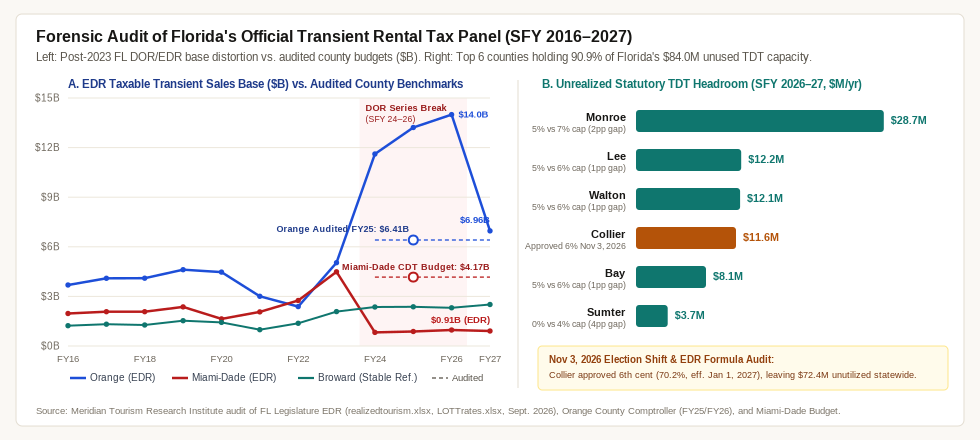
A second structural distortion inside the same official release is far larger than the formula error. Because Florida’s largest tourism counties self-administer their TDT locally while EDR derives county taxable transient-rental sales from Florida Department of Revenue (DOR) sales-tax Kind Code filings, multi-county consolidated returns and marketplace-facilitator reporting shifts created dramatic post-2023 discontinuities. In Orange County, EDR’s estimated transient rental sales base jumped +130.6 percent overnight from $5.04 billion in SFY 2022–23 to $11.61 billion in SFY 2023–24, peaked at $14.00 billion in SFY 2025–26 (implying $839.9 million in 6 percent TDT), and then dropped -50.2 percent to $6.96 billion in SFY 2026–27. Audited Orange County Comptroller reports confirm actual record FY 2025 TDT receipts were $384.6 million ($6.41 billion implied base) and grew +7.5 percent in FY 2026 (~$413.4 million, or $6.89 billion base), confirming that EDR’s SFY 2024–26 Orange County estimates overstated reality by more than $420 million per year before re-anchoring in SFY 2026–27.3
The mirror-image error appears in Miami-Dade County, where EDR’s estimated taxable transient rental base plunged -81.7 percent from $4.49 billion in SFY 2022–23 to $0.82 billion in SFY 2023–24 and remains at just $0.91 billion ($27.23 million implied CDT) in SFY 2026–27. Miami-Dade County’s own operational budget schedules project $125.05 million in 3 percent CDT proceeds (implying roughly $4.17 billion in taxable countywide lodging sales) and report $48.60 million in actual FY 2024–25 collections from the 2 percent mainland TDT alone ($2.43 billion outside Miami Beach, Bal Harbour, and Surfside, which levy a separate 4 percent Municipal Resort Tax).4 Similar post-2023 swings appear in Polk (+130.3 percent then -56.6 percent), Volusia (-44.7 percent then +84.1 percent), and Okaloosa (-42.7 percent in SFY 2026–27). Taken raw, EDR’s statewide realized TDT total drops -$492.4 million (-22.6 percent) between SFY 2025–26 ($2.175 billion) and SFY 2026–27 ($1.683 billion)—an accounting artifact rather than an actual statewide tourism downturn.
Unused coastal taxing headroom and Collier County’s November 3, 2026 vote
Auditing statutory tax ceilings alongside current county rates reveals that Florida’s remaining unused TDT capacity is heavily concentrated along hurricane-exposed coastlines. In EDR’s SFY 2026–27 baseline (using rates as of February 1, 2026), statewide unrealized TDT capacity totaled $84.00 million across 18 counties below their statutory ceiling, with just five coastal counties holding $72.69 million (86.5 percent): Monroe County ($28.73 million; 5 percent enacted vs. 7 percent maximum including the 1 percent Tourist Impact Tax), Lee County ($12.20 million; 5 percent vs. 6 percent), Walton County ($12.07 million), Collier County ($11.59 million), and Bay County ($8.11 million).
On November 3, 2026, Collier County voters approved Ordinance 2025-33 by 70.2 percent, adopting the sixth cent effective January 1, 2027 (moving Naples and Collier County from 11.0 percent to 12.0 percent combined, as Collier’s 1 percent local sales surtax had already sunset). That single referendum converts $11.59 million from unrealized to realized revenue and leaves Monroe, Lee, Walton, and Bay counties holding $61.11 million—84.4 percent of Florida’s remaining $72.41 million in unutilized statutory TDT capacity. Separately, Palm Beach County’s combined lodging tax fell from 13.0 percent to 12.5 percent on January 1, 2026 after its 1 percent infrastructure surtax gave way to a 0.5 percent school capital outlay surtax, illustrating why combined sales-plus-TDT tracking must pair both EDR schedules.
Two-way fixed effects panel elasticity across 48 county rate changes
To measure whether county TDT increases measurably shrink taxable lodging sales once statewide demand cycles are held constant, we estimated a two-way fixed effects (TWFE) log-linear model—ln(Sales_it) = alpha_i + gamma_t + beta * LocalRate_it + eps_it—with standard errors clustered at the county level across the clean pre-break 14-year panel (SFY 2009–10 through SFY 2022–23; 67 counties, N = 938 county-years, 48 enacted rate changes). Across all 67 counties, a +1 percentage point local rate increase is associated with beta = -0.0313 (clustered SE = 0.0328, t = -0.95; 95 percent CI: -9.6 percent to +3.3 percent). Restricting to the pre-COVID decade (SFY 2010–2019, N = 670, 37 rate changes) yields beta = -0.0361 (SE = 0.0416, t = -0.87). Restricting to Florida’s 34 major tourism counties (at least $100 million in FY 2022–23 sales, N = 476, 22 rate changes) yields beta = +0.0244 (SE = 0.0278, t = +0.88), and excluding the five post-2023 DOR-break counties over the full 18-year horizon (N = 1,116, 52 rate changes) yields beta = -0.0477 (SE = 0.0354, t = -1.35).
In a complementary non-COVID event study of 11 clean +1 percentage point county hikes (bases exceeding $10 million), hiking counties experienced a median Year 0 excess sales growth of -4.29 percentage points relative to unchanged Florida peer counties (including Broward at -6.5pp, Collier at -6.6pp, and Palm Beach at -12.7pp in transition years), but recovered to a median cumulative Year +1 excess growth of -0.06 percentage points (Broward -0.1pp, Palm Beach +1.9pp, Pinellas +6.3pp). Two economic mechanisms explain why severe permanent base erosion does not materialize in major Florida counties: policy endogeneity (fast-growing coastal destinations self-select into adopting higher TDT tiers) and statutory earmarking (under Section 125.0104, incremental bed-tax revenue directly finances destination marketing and beach renourishment that shift visitor demand outward). Conversely, if state legislation redirects TDT revenue entirely toward general-fund property-tax offsets without preserving demand-generating investments, counties should expect net tax-base elasticity to become more negative than historical Section 125.0104 averages. The full 1,206-row replication panel with anomaly flags is openly archived under CC BY 4.0.5
Notes and primary sources
- 1
Florida Statutes § 125.0104 (Local Option Tourist Development Act), § 125.0108 (Tourist Impact Tax), § 212.0305 (Convention Development Taxes), and § 509.032(7)(b); Florida Legislature 2025–2026 bills HB 6031, HB 6007, and SB 458.
- 2
Florida Legislature Office of Economic and Demographic Research (EDR), Local Option Tourist Tax Levies in Florida’s Counties: Estimation of Realized and Unrealized Tax Revenues (realizedtourism.xlsx, SFY 2009–10 through SFY 2026–27), LOTTrates.xlsx, LDSSrates.xlsx, and FY2027transientrentals-Sept2026.xlsx, accessed November 24, 2026 at edr.state.fl.us.
- 3
Orange County Comptroller’s Office (occompt.com), Tourist Development Tax Annual Financial Reports: FY 2025 record collections ($384.6M) and FY 2026 annual TDT growth (+7.5%; amended budget $415.0M).
- 4
Miami-Dade County Office of Management and Budget (miamidade.gov), Convention Development Tax budget schedule ($125.052M) and FY 2024–25 actual 2% Tourist Development Tax receipts ($48.601M); City of Miami Beach Code Ch. 102 Art. IV (4% Municipal Resort Tax); Collier County Ordinance 2025-33 (approved Nov. 3, 2026, eff. Jan. 1, 2027); Palm Beach County Tax Collector (pbctax.gov, 6.5% sales tax eff. Jan. 1, 2026).
- 5
Meridian Tourism Research Institute, Audited 67-County Florida Local Option Tourist Tax Replication Panel (SFY 2010–2027, 1,206 county-years, CSV), open access under CC BY 4.0 at https://meridiantourismri.org/assets/data/fl_edr_tourist_tax_panel_sfy2010_sfy2027.csv.
Cite this publication
Saechueng, Chaiwat, and Mukesh Thakur. 2026. “Forensic Audit and Panel Elasticity of Florida’s Local Option Tourist Tax System (SFY 2010–2027).” Meridian Working Paper WP 2026-34, November 24, 2026. https://doi.org/10.5281/zenodo.24492663.
@techreport{mtri_wp_2026_34,
  author      = {Saechueng, Chaiwat and Thakur, Mukesh},
  title       = {Forensic Audit and Panel Elasticity of Florida’s Local Option Tourist Tax System (SFY 2010–2027)},
  institution = {Meridian Tourism Research Institute},
  type        = {Working Paper},
  number      = {WP 2026-34},
  address     = {New York, NY},
  year        = {2026},
  month       = {November},
  doi         = {10.5281/zenodo.24492663},
  url         = {https://meridiantourismri.org/articles/florida-local-option-tourist-tax-forensic-audit-sfy2010-2027.html}
}