

Evaluating America’s first state climate “Green Fee” with audited Form TA-1 microdata
On January 1, 2026, Hawaii Act 96 (SLH 2025, Senate Bill 1396) made Hawaii the first U.S. state to enact an explicit climate-resilience tourism surcharge, raising the state Transient Accommodations Tax (TAT) under HRS Chapter 237D (stays under 180 consecutive days) by 0.75 percentage points from 10.25 percent to 11.00 percent. Because all four Hawaii counties—Honolulu (Oahu), Maui, Hawaii County, and Kauai—simultaneously levy the 3.0 percent county TAT surcharge and the 0.5 percent county General Excise Tax (GET) surcharge (following Maui’s adoption effective January 1, 2024 through December 31, 2030), Act 96 lifted Hawaii’s uniform statewide lodging checkout tax stack to 18.712 percent. Hours before enactment, however, the U.S. Court of Appeals for the Ninth Circuit enjoined Act 96’s parallel extension of the 11.0 percent TAT to prorated cruise-ship fares in Cruise Lines International Association, Inc. v. Suganuma (Nos. 25-8057/25-8058), prompting Hawaii Department of Taxation (DOTAX) Announcement No. 2026-01 (January 2, 2026) to suspend cruise-fare filings while enforcing the 11.0 percent land lodging rate in full.1
Rather than relying on visitor surveys or legislative fiscal notes, we compiled all 23 consecutive monthly Hawaii DOTAX Transient Accommodations Tax Liabilities and Tax Base by District reports spanning July 2024 through May 2026 (92 county-months; reconciled horizontally to within $1.00 across districts and vertically to within $0.48 against DOTAX’s prior-year columns; latest May 2026 release dated September 20, 2026). We paired these filings with official Form G-45 General Excise and Use Tax district base reports (January–May 2026 and cumulative FY 2026 vs. FY 2025) covering Retailing ($46.42 billion 11-month FY26 base), Services ($19.86 billion), and Hotel Rentals ($6.78 billion) to construct an internal untreated control group experiencing zero tax-rate change on January 1, 2026.2
| County / Control Sector | Pre H1 YoY (Jul–Dec ’25) | Post 5-Mo YoY (Jan–May ’26) | Pre→Post Shift | Jan–May ’26 Base | Post Liab. YoY | 5-Mo 0.75% Green Fee |
|---|---|---|---|---|---|---|
| Oahu District (Honolulu) | +0.67% | -1.17% | -1.84 pp | $1,355.3M | +6.06% | $10.16M |
| Maui District (Wildfire Rec.) | +8.29% | +3.69% | -4.60 pp | $1,055.9M | +11.28% | $7.92M |
| Hawaii District (Big Island) | +4.55% | +4.83% | +0.28 pp | $549.2M | +12.50% | $4.12M |
| Kauai District | +4.63% | -0.53% | -5.16 pp | $438.9M | +6.75% | $3.29M |
| Statewide TAT Total (All 4) | +3.79% | +1.33% | -2.47 pp | $3,399.2M | +8.74% | $25.49M |
| Ex-Maui Clean Triad (3 Cty) | +2.14% | +0.30% | -1.84 pp | $2,343.3M | +7.64% | $17.57M |
| Control: GE Retailing (4%) | +4.19% | +4.83% | +0.65 pp | $21,366M | Unchanged | Untreated |
| Control: GE Services (4%) | +3.87% | +0.76% | -3.12 pp | $8,998M | Unchanged | Untreated |
| Control: GE Retail + Svc. | +4.09% | +3.61% | -0.49 pp | $30,364M | Unchanged | DiD: -1.98pp / -1.36pp |
Forensic finding 1: A $29.51 million retroactive rate bug in official DOTAX FY 2026 tables
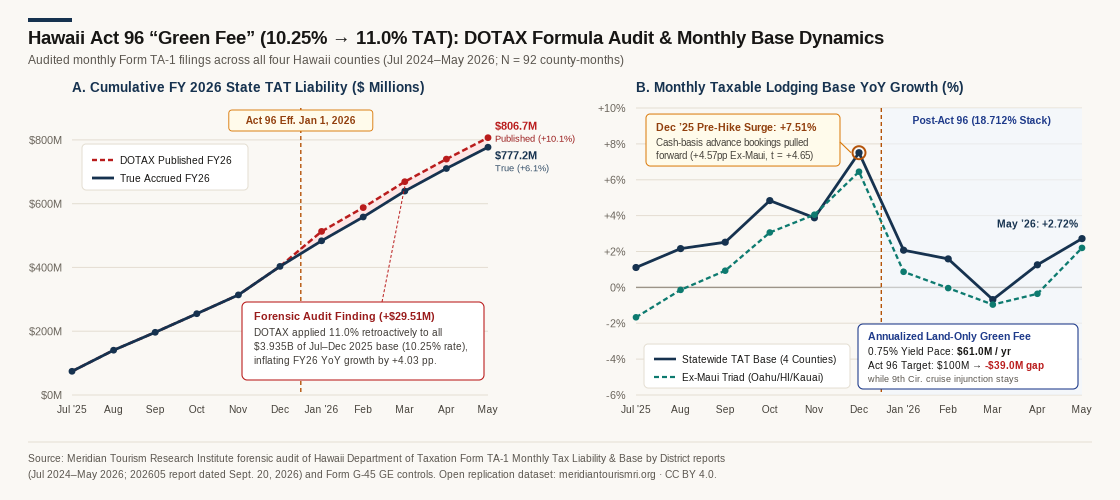
Auditing Column H (Cumulative Totals FY 2026) across successive monthly Form TA-1 Excel workbooks and published PDFs exposes an exact mechanical formula error triggered on January 1, 2026. Through December 2025—the close of the first half of Hawaii’s July-to-June fiscal year—cumulative FY 2026 taxable lodging sales totaled $3,934,592,038 ($3,719,719,733 transient accommodations plus $214,872,305 timeshare occupancy) and cumulative accrued tax liability equaled exactly 10.25 percent of that base ($403,295,684). Beginning with the January 2026 report, however, DOTAX’s automated reporting script multiplied the entire cumulative FY 2026 tax base from July 1, 2025 onward by the new 11.00 percent rate instead of summing monthly accrued liabilities under each statutory regime.
That single pipeline bug retroactively applied Act 96’s 0.75 percent Green Fee to $3.935 billion of pre-Act-96 July–December 2025 lodging sales, manufacturing an exact +$29,509,440.28 phantom revenue overstatement ($27,897,898.00 transient accommodations plus $1,611,542.29 timeshare occupancy). In January 2026, true cumulative FY 2026 liability equaled $483.47 million (+4.70 percent YoY), yet DOTAX printed $512.98 million (+11.09 percent YoY)—a +6.39 percentage-point distortion. The identical $29.51 million error persisted uncorrected through February, March, April, and May 2026, where DOTAX’s latest September 20, 2026 release prints cumulative FY 2026 liability as $806.72 million (+10.14 percent YoY) instead of true accrued liability of $777.21 million (+6.12 percent YoY), inflating reported fiscal-year TAT growth by +4.03 percentage points. Update (November 24, 2026): Within 24 minutes of receiving Meridian’s reconciliation note, the Hawaii Department of Taxation’s Tax Research and Planning Officer thanked Meridian for flagging the discrepancy and confirmed the FY 2026 cumulative files will be corrected.
Forensic finding 2: The $39.0 million annual climate-fund gap under the cruise injunction
Governor Josh Green and the Hawaii Legislature projected Act 96 would raise approximately $100 million annually for wildfire prevention, coastal resilience, and environmental stewardship by combining the 0.75-percentage-point land TAT hike with the new prorated 11.0 percent cruise-ship fare tax. With cruise-fare taxation enjoined pending Ninth Circuit merits review (oral argument held April 2026), audited Form TA-1 filings establish for the first time how much the land-only Green Fee actually generates.
Across the first five full months of Act 96 (January–May 2026), statewide taxable lodging sales totaled $3,399.2 million, yielding exactly $25.49 million from the 0.75 percent climate increment ($10.16 million on Oahu, $7.92 million on Maui, $4.12 million on Hawaii Island, and $3.29 million on Kauai). Applying Calendar Year 2025’s exact January–May seasonal share (41.83 percent of $8.021 billion) implies a seasonally annualized CY 2026 taxable lodging base of $8.127 billion and a land-only 0.75 percent Green Fee yield of $60.95 million per year ($60.49 million on the trailing 12-month June 2025–May 2026 base of $8.065 billion). Until federal appellate courts resolve CLIA v. Suganuma, Hawaii faces a recurring ~$39.0 million annual funding gap (39 percent) relative to its headline $100 million climate-resilience target.3
Anticipatory cash-basis pull-forward (+7.51% in Dec. 2025) and Difference-in-Differences demand test
Audited monthly filings also reveal classic intertemporal tax-timing behavior around the January 1, 2026 threshold. Hawaii DOTAX Announcement No. 2025-03 (June 9, 2025) clarified that cash-basis taxpayers owed the legacy 10.25 percent rate on advance deposits and rental proceeds actually or constructively received prior to January 1, 2026. Consistent with advance-payment pull-forward, statewide taxable TAT base jumped +7.51 percent YoY in December 2025 (Maui +10.09 percent, Hawaii Island +10.28 percent, Kauai +5.86 percent, Oahu +5.06 percent). In an island-fixed-effects panel regression of monthly YoY log base growth (N = 44 island-months, July 2025–May 2026), the December 2025 anticipation dummy equals +3.97 percentage points statewide (HC1 SE = 0.82 pp, t = +4.82) and +4.57 percentage points across the non-wildfire Ex-Maui triad (HC1 SE = 0.98 pp, t = +4.65); smoothing across the January 1 boundary (December 2025 plus January 2026 combined) yields +4.97 percent YoY.
Across January–May 2026 under the 18.712 percent combined stack (+0.634 percent all-in guest price change from 117.962 percent to 118.712 percent), statewide taxable lodging sales still grew +1.33 percent YoY ($3.355 billion to $3.399 billion) and true accrued state TAT liability climbed +8.74 percent YoY (+$30.05 million in five months: $343.85 million to $373.91 million). Relative to Hawaii’s unchanged Form G-45 General Excise Retailing + Services control base (+4.09 percent in H1 FY26 to +3.61 percent in Jan–May 2026, a -0.49 pp shift), raw Difference-in-Differences yields -1.98 pp statewide (-1.36 pp Ex-Maui; -1.06 pp on GE Hotel Rentals). Crucially, once we exclude Maui’s normalizing post-2023 Lahaina wildfire recovery (+8.29 percent to +3.69 percent) and control for the December 2025 cash-basis pull-forward, the clean post-Act-96 shift across Oahu, Hawaii Island, and Kauai shrinks to -1.16 percentage points (HC1 SE = 1.02 pp, t = -1.14; month-clustered SE = 0.78 pp, t = -1.50)—statistically indistinguishable from zero at the 5 percent level. By May 2026, all four counties had returned to positive YoY taxable base growth (statewide +2.72 percent, Oahu +1.34 percent, Maui +4.03 percent, Hawaii Island +5.67 percent, Kauai +1.47 percent), matching DBEDT/STR’s May–July 2026 statewide RevPAR gains (+5.3 percent to +9.9 percent). Separately, comparing 11-month FY 2026 Form TA-1 transient accommodations ($6.937 billion) against Form G-45 GE Hotel Rentals ($6.779 billion) isolates a $157.7 million (+2.33 percent) non-hotel vacation-rental and STR reporting wedge.4
Governance actions for DOTAX, the Council on Revenues, and climate-fee states
Three concrete recommendations follow for Hawaii fiscal officials and mainland coastal states evaluating environmental tourism surcharges. First, Hawaii DOTAX Tax Research and Planning should issue an errata or segmented rate-period formula for its FY 2026 Form TA-1 cumulative tables so fiscal-year totals sum monthly liabilities accrued at 10.25 percent (July–December 2025) and 11.00 percent (January–June 2026) rather than applying 11.00 percent retroactively. Second, legislative capital planners and wildfire-resilience agencies should budget around a realistic $60 million to $62 million annual land-only Green Fee baseline—not $100 million—unless and until the Ninth Circuit reverses or lifts the CLIA v. Suganuma cruise injunction. Third, while early audited evidence shows no aggregate lodging-base collapse at Hawaii’s 18.712 percent stack, Oahu’s softer Q1 2026 taxable sales (-1.17 percent across January–May) warrant close tracking as statewide hotel ADR climbs toward $370 to $398 per night. The complete 115-row audited replication CSV and permanent PDF archive are released openly under CC BY 4.0.5
Notes and primary sources
- 1
State of Hawaii, Act 96, Session Laws of Hawaii 2025 (SB 1396; HRS Ch. 237D); Hawaii DOTAX Announcement No. 2025-03 (June 9, 2025) & Announcement No. 2026-01 (Jan. 2, 2026); Cruise Lines Int’l Ass’n, Inc. v. Suganuma, 9th Cir. Nos. 25-8057 & 25-8058 (Injunction Dec. 31, 2025; Clarification Jan. 2, 2026; Oral Argument April 2026).
- 2
Hawaii Department of Taxation, Tax Research and Planning, Monthly Transient Accommodations Tax Liabilities and Tax Base by District (202407–202605, Form TA-1, May 2026 release dated Sept. 20, 2026) & Monthly General Excise and Use Tax Liabilities by District (202601–202605, Form G-45), tax.hawaii.gov/stats/a5_3txcolrpt/.
- 3
Office of the Governor of Hawaii & State Legislature Act 96 fiscal estimates (~$100M/yr combined land + cruise projection); Hawaii DOTAX County Surcharge on General Excise and Use Tax (4.7120% uniform statewide maximum pass-on through Dec. 31, 2030), tax.hawaii.gov/geninfo/countysurcharge/.
- 4
Hawaii Department of Business, Economic Development & Tourism (DBEDT) / STR, Inc. Monthly Hawaii Hotel Performance Reports (April–September 2026), dbedt.hawaii.gov/economic/visitor/.
- 5
Meridian Tourism Research Institute, 23-Month Audited Hawaii DOTAX Act 96 TAT County-Month Replication Panel (Jul 2024–May 2026, CSV, 115 rows) & Working Paper WP 2026-35, CERN Zenodo DOI: https://doi.org/10.5281/zenodo.24505268; CSV at https://meridiantourismri.org/assets/data/hi_dotax_act96_tat_panel_2024_2026.csv.
Cite this publication
Saechueng, Chaiwat, and Mukesh Thakur. 2026. “Early Audited Evidence on Hawaii’s Act 96 Climate “Green Fee” (2024–2026): A $29.5 Million DOTAX Reporting Overstatement, Anticipatory Pre-Hike Booking Pull-Forward, and Cruise-Injunction Revenue Gap.” Meridian Working Paper WP 2026-35, November 24, 2026. https://doi.org/10.5281/zenodo.24505268.
@techreport{mtri_wp_2026_35,
  author      = {Saechueng, Chaiwat and Thakur, Mukesh},
  title       = {Early Audited Evidence on Hawaii’s Act 96 Climate “Green Fee” (2024–2026): A $29.5 Million DOTAX Reporting Overstatement, Anticipatory Pre-Hike Booking Pull-Forward, and Cruise-Injunction Revenue Gap},
  institution = {Meridian Tourism Research Institute},
  type        = {Working Paper},
  number      = {WP 2026-35},
  address     = {New York, NY},
  year        = {2026},
  month       = {November},
  doi         = {10.5281/zenodo.24505268},
  url         = {https://meridiantourismri.org/articles/hawaii-act-96-green-fee-forensic-audit-2024-2026.html}
}