
What GLAMOS mass-balance series show from 2022 to 2025
Switzerland’s Glacier Monitoring Network (GLAMOS), operated by ETH Zurich and the Universities of Fribourg and Zurich, maintains some of the longest continuous glaciological records on earth. Between 2022 and 2025 those records crossed a structural threshold: Swiss glaciers lost 6 percent of their remaining ice volume in 2022, another 4 percent in 2023, 2.4 percent in 2024, and roughly 3 percent in 2025—wiping out roughly one-quarter of total national glacier volume in a single decade.1
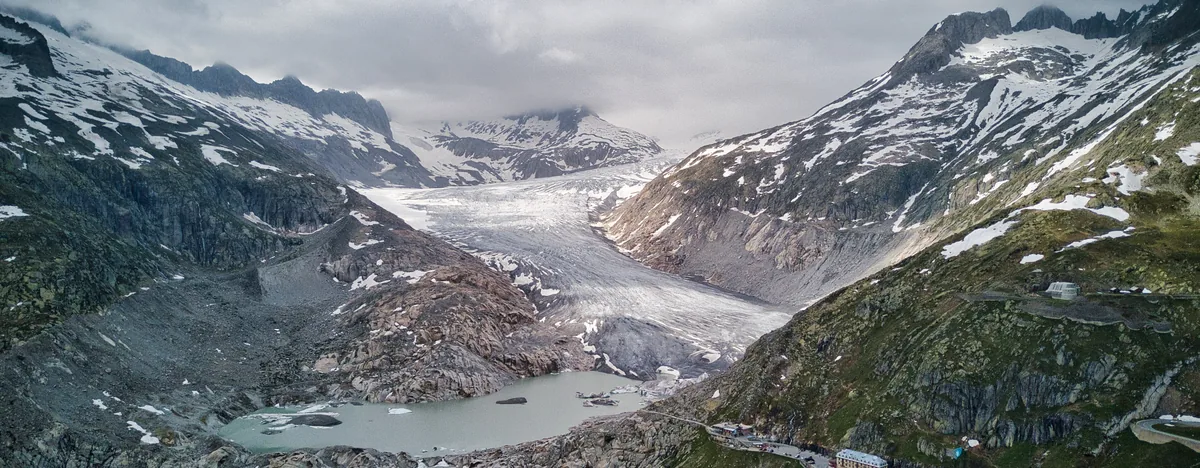
At the Furka Pass in Valais, where travelers since the nineteenth-century Grand Tour stopped at the Hotel Belvédère to walk inside a hand-carved tunnel in the Rhône Glacier, the glacier snout has retreated up-valley into a deepening proglacial basin, severing the historic sightline from the valley floor.
| Hydrological year | Annual ice-volume change | Snowpack & summer driver | Operational impact on alpine tourism |
|---|---|---|---|
| 2021–2022 | -6.0% (~3 km³) | Winter snow drought + Saharan dust + summer heatwaves | July closure of high-alpine mountaineering routes (Jungfrau / Matterhorn rockfall) |
| 2022–2023 | -4.0% (~2.2 km³) | Low winter accumulation + record high August zero-degree line (5,298 m) | Loss of thin remnant snowfields; summer ski suspension at Zermatt/Saas-Fee periods |
| 2023–2024 | -2.4% | Deep spring snowpack buffered early melt before warm August | Delayed rockfall until late August; continued proglacial lake expansion |
| 2024–2025 | ~-3.0% | Below-average winter snow + June/August heatwaves | Cumulative 2015–2025 Swiss ice loss reached ~25% of total volume |
The economics and physical ceiling of white geotextile blankets
Each spring since the early 2010s, operators of the Rhône Glacier ice grotto—along with ski resorts anchoring cable-car pylons and snowparks on the Gurschen, Presena, and Stubai glaciers—unroll strips of white non-woven polypropylene geotextile across several thousand square meters of ice.2 By raising surface albedo and insulating the ice beneath, clean fleece cuts local summer ablation by 50 to 70 percent directly under the fabric.
A 2021 glaciological cost-effectiveness synthesis by Huss, Fischer, and colleagues at ETH Zurich / WSL calculated why the technique cannot scale beyond tiny commercial assets: purchasing, transporting by helicopter or snowcat, sewing, anchoring against Foehn winds, and removing fleece each autumn costs roughly CHF 5 to CHF 8 per cubic meter of ice saved—and shedding microfibers onto alpine meltwater raises growing environmental scrutiny.2 Covering even 1 percent of Swiss glacier area would cost hundreds of millions of francs annually without halting basal melt.
Trail re-routing and 'last-chance' visitor surges
For alpine municipalities, retreating ice transforms visitor management from marketing into civil engineering. Thawing permafrost destabilizes moraine walls above classic huts and hiking trails, forcing the Swiss Alpine Club (SAC) and cantonal trail services to re-route paths onto suspension bridges, install rockfall radar, or shift recommended climbing seasons from August into May and June. Meanwhile, 'last-chance' sightseeing brings day visitors to viewing platforms precisely as access terrain becomes more hazardous—requiring towns from Chamonix (which introduced hut booking mandates on the Mont Blanc normal route) to Pontresina and Gletsch to rewrite how they price and regulate high-mountain access.
Notes and primary sources
- 1
GLAMOS (Glacier Monitoring in Switzerland) and Swiss Commission for Cryosphere Observation of the Swiss Academy of Sciences (SCNAT), “Two catastrophic years obliterate 10% of Swiss glacier volume,” September 28, 2023; GLAMOS and SCNAT, “And Swiss glaciers continue to melt,” October 1, 2025; Agence France-Presse, “Swiss glaciers shrank by a quarter in past decade: study,” October 1, 2025.
- 2
Matthias Huss, Mauro Fischer, Andreas Bauder, and Daniel Farinotti, “Artificial glacier melt suppression by geotextiles in Switzerland: local effectiveness vs. regional infeasibility,” Water / ETH Zurich glaciology series (2021); Agence France-Presse, “Blankets cover Swiss glacier in vain effort to halt icemelt,” September 15, 2015.
Cite this publication
Saechueng, Chaiwat, and Mukesh Thakur. 2026. “Geotextile Blankets and Retreating Ice: Swiss Glacier Towns Under 25 Percent Decadal Volume Loss.” Meridian Field Dispatch FD 2026-11, June 3, 2026. https://doi.org/10.5281/zenodo.24355871.
@techreport{mtri_fd_2026_11,
  author      = {Saechueng, Chaiwat and Thakur, Mukesh},
  title       = {Geotextile Blankets and Retreating Ice: Swiss Glacier Towns Under 25 Percent Decadal Volume Loss},
  institution = {Meridian Tourism Research Institute},
  type        = {Field Dispatch},
  number      = {FD 2026-11},
  address     = {New York, NY},
  year        = {2026},
  month       = {June},
  doi         = {10.5281/zenodo.24355871},
  url         = {https://meridiantourismri.org/articles/alpine-glacier-retreat-fleece-blankets-switzerland.html}
}