
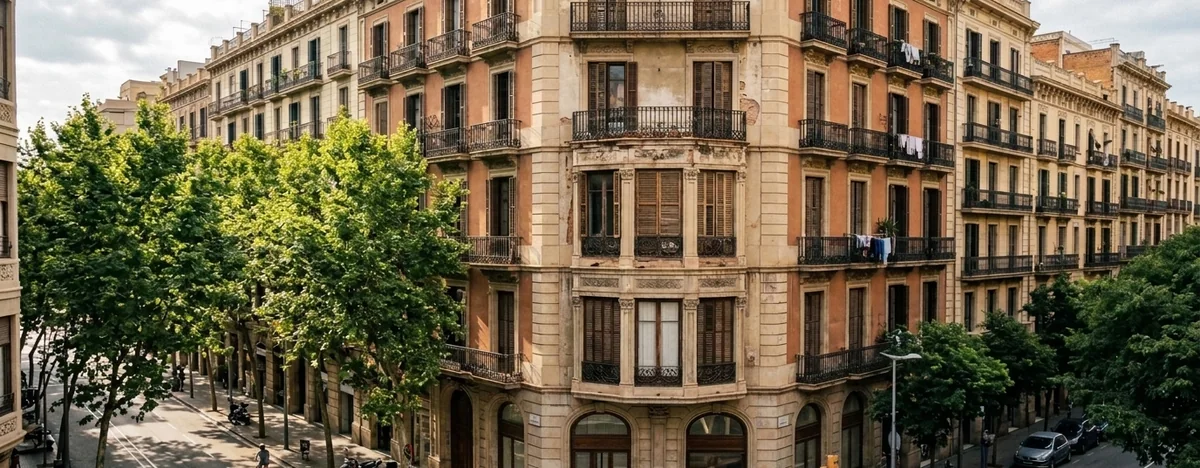
Why freezing licenses in 2014 created a scarcity rent
For nearly a decade after Barcelona froze new tourist-apartment permits and adopted its Special Urban Plan for Tourist Accommodation (PEUAT), existing Habitatges d’Ús Turístic (HUT) licenses functioned like New York taxi medallions. Because a grandfathered HUT license was attached to the property without an expiration date while no competing licenses could be issued in Eixample, Ciutat Vella, or Gràcia, apartments carrying a tourist license traded at substantial price premiums over identical flats on the same stairwell.1
Municipal enforcement shut down thousands of unlicensed listings between 2016 and 2023, yet the 10,101 legally licensed tourist apartments remained untouchable so long as revoking an indefinite license risked billions of euros in administrative compensation claims.
| Date | Instrument | Legal change | Market effect |
|---|---|---|---|
| 2014–2017 | License freeze & PEUAT urban plan | Capped HUT licenses in central zones; zero new permits in Zone 1 | Froze legal stock near ~10,000; inflated resale value of grandfathered licenses |
| Nov. 7, 2023 | Catalan Decree-Law 3/2023 | Required urban-planning permit in 262 stressed towns; set 5-year sunset on existing HUTs | Started five-year statutory amortization clock running to Nov. 2028 |
| June 21, 2024 | Barcelona municipal announcement | Mayor announced zero renewals when the five-year transition ends | Anchored November 2028 non-renewal expectation |
| March 13, 2025 | Constitutional Court STC 64/2025 | Dismissed property-rights & takings challenge under Art. 33 of the Spanish Constitution | Removed primary domestic constitutional obstacle; EU litigation avenues remain watched |
How Decree-Law 3/2023 and Sentencia 64/2025 solved the compensation problem
Catalonia’s Decree-Law 3/2023 of November 7, 2023 reframed tourist accommodation in 262 housing-stressed municipalities as a conditional urban land-use exception rather than a vested perpetual property right. Existing license holders received a five-year transitional regime—extendable by five years only if the owner proves irreparable uncompensated investment loss—at the end of which the tourist use lapses unless the municipality affirmatively grants a new five-year urban planning authorization.2
On June 21, 2024, Mayor Jaume Collboni announced that Barcelona would grant zero renewals when the transitional period ends in November 2028.1 Opposition deputies challenged Decree-Law 3/2023 before Spain’s Constitutional Court, arguing that extinguishing perpetual permits violated Article 33 (private property and compensation for expropriation) and Article 38 (freedom of enterprise) of the Spanish Constitution. On March 13, 2025, in Sentencia 64/2025, the plenary court rejected the challenge, holding that delineating residential vs. tourist land use regulates the social function of property rather than expropriating title, and that the five-year statutory sunset provides constitutional proportionality.2
Three margins to watch before and after November 2028
Because November 2028 is an announced, pre-scheduled sunset rather than a sudden ban, Barcelona offers researchers a rare anticipated policy shock. Three empirical margins deserve close tracking between 2026 and 2030. First, capitalization into sale prices: the resale premium between HUT-licensed apartments and unlicensed apartments in Dreta de l’Eixample should decay linearly toward zero as remaining tourist-operating months shrink.
Second, substitution into seasonal contracts (arrendamientos de temporada of 32 days to 11 months): under Spain’s 2023 Housing Law (Ley 12/2023), long-term residential leases in stressed zones face rent-index caps, creating a strong financial incentive for former HUT landlords to pivot toward medium-term digital-nomad or student leases unless Catalonia’s regional rules on seasonal rentals hold firm. Third, neighborhood concentration: although 10,101 units equal just 1.3 percent of Barcelona’s citywide housing stock, they exceed 8 to 12 percent of residential dwellings on specific blocks around Sagrada Família, Passeig de Gràcia, and Barceloneta—precisely the streets where localized rent and population effects should be measurable.
Notes and primary sources
- 1
Ajuntament de Barcelona, “Barcelona no renovarà les llicències d’habitatges d’ús turístic,” June 21, 2024; Catalan News, “Barcelona announces it will remove all tourist apartments in four years,” June 21, 2024; The Guardian, “Barcelona to ban apartment rentals to tourists in bid to cut housing costs,” June 22, 2024.
- 2
Tribunal Constitucional de España, Pleno, Sentencia 64/2025, de 13 de marzo de 2025, Recurso de inconstitucionalidad 798-2024 (against Decreto-ley 3/2023, de 7 de noviembre, de la Generalitat de Cataluña, de medidas urgentes sobre el régimen urbanístico de las viviendas de uso turístico), Boletín Oficial del Estado núm. 88, April 11, 2025; Reuters, “Spain’s top court backs Barcelona’s plan to ban holiday apartments,” March 13, 2025.
Cite this publication
Saechueng, Chaiwat, and Mukesh Thakur. 2026. “Barcelona’s 2028 Sunset on 10,101 Tourist Apartments After Spain’s Constitutional Court Ruling 64/2025.” Meridian Policy Note PN 2026-03, October 8, 2026. https://doi.org/10.5281/zenodo.24355850.
@techreport{mtri_pn_2026_03,
  author      = {Saechueng, Chaiwat and Thakur, Mukesh},
  title       = {Barcelona’s 2028 Sunset on 10,101 Tourist Apartments After Spain’s Constitutional Court Ruling 64/2025},
  institution = {Meridian Tourism Research Institute},
  type        = {Policy Note},
  number      = {PN 2026-03},
  address     = {New York, NY},
  year        = {2026},
  month       = {October},
  doi         = {10.5281/zenodo.24355850},
  url         = {https://meridiantourismri.org/articles/barcelona-2028-tourist-apartment-sunset.html}
}