
Kyoto’s progressive lodging tax: fiscal extraction without deterring domestic budget travelers
When Kyoto raised the top bracket of its municipal accommodation tax from ¥1,000 to ¥10,000 (~$66 USD) per person per night on March 1, 2026—following formal consent from Japan’s Ministry of Internal Affairs and Communications—it enacted the highest flat municipal lodging levy in Japanese history.1 Yet the ordinance’s five-step structure leaves the bottom bracket (stays under ¥6,000 per person, typical of school excursions, hostels, and domestic business hotels) untouched at ¥200, while raising mid-market rooms (¥6,000–¥19,999) by only ¥200.
That design reflects an explicit political and economic calculation. In Kyoto, public anger centered on overcrowded municipal buses to Kiyomizu-dera and Arashiyama, where transit fares had been held flat for residents while luxury international hotel chains expanded rapidly on former institutional land. Because high-end foreign leisure guests paying ¥120,000 ($800) per night for a luxury ryokan or five-star hotel exhibit low price elasticity, a ¥10,000 per-person charge is projected to more than double Kyoto’s annual accommodation-tax revenue toward ¥12.6 billion (~$83 million)—funding dedicated express tourist buses and luggage-forwarding subsidies—without pricing out Japanese domestic students.
| Nightly room rate per person (pre-tax) | 2018–Feb. 2026 tax | From March 1, 2026 | Approximate effective tax rate |
|---|---|---|---|
| Under ¥6,000 | ¥200 | ¥200 (unchanged) | 3.3% at top of bracket |
| ¥6,000 to ¥19,999 | ¥200 | ¥400 | 2.0% to 6.7% |
| ¥20,000 to ¥49,999 | ¥500 | ¥1,000 | 2.0% to 5.0% |
| ¥50,000 to ¥99,999 | ¥1,000 | ¥4,000 | 4.0% to 8.0% |
| ¥100,000 and above | ¥1,000 | ¥10,000 | ≤10.0% (declining above ¥100k) |
Mount Fuji’s paired price-and-gate experiment (2024–2026)
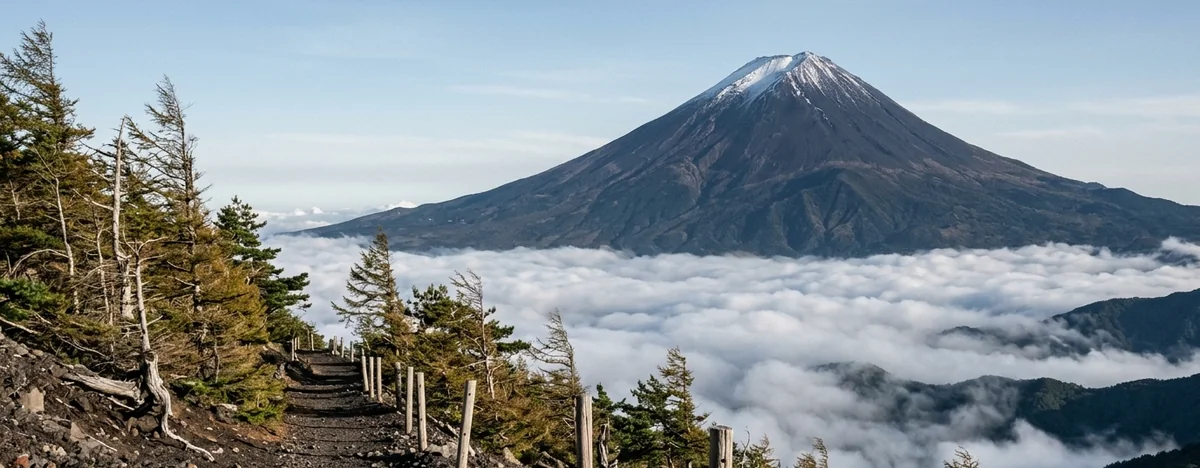
On Mount Fuji, where over 60 percent of climbers use Yamanashi Prefecture’s Yoshida Trail, prefectural officials combined a fee with two hard physical rules. In July 2024 Yamanashi introduced a mandatory ¥2,000 entry fee, capped non-hut hikers at 4,000 per day, and installed a physical wooden gate at the 5th Station that closed from 4:00 p.m. to 3:00 a.m. unless a climber held a confirmed overnight mountain-hut reservation.2
First-season data from summer 2024 exposed a spillover risk: while Yoshida Trail ascents fell roughly 14 percent from 2023 and late-night 'bullet climbing' rescues dropped markedly, climbers migrated to the three uncharged trails on the Shizuoka Prefecture side of the volcano. In response, Yamanashi and Shizuoka coordinated ordinances for the 2025 season (retained in 2026): all four trails now charge a mandatory ¥4,000 fee, Yamanashi moved its afternoon gate closure two hours earlier to 2:00 p.m., and Shizuoka barred post-2:00 p.m. entries for hikers without hut bookings.2
Why time-of-day gates succeeded where fees alone would not
Mount Fuji’s two-stage rollout demonstrates a core principle of fragile-site management. At ¥4,000 (~$26 USD), the climbing fee easily pays for English-speaking trail rangers, safety helmets, and high-altitude shelters, yet on clear August weekends the 4,000-climber cap and the 2:00 p.m. curfew—not the fee—prevent summit-crater bottlenecks at sunrise. Closing the Shizuoka backdoor in year two also illustrates why single-gate caps on multi-access natural sites require inter-jurisdictional coordination from day one.
Notes and primary sources
- 1
Kyoto City Official Notice on Revision of the Accommodation Tax (effective March 1, 2026, following Ministry of Internal Affairs and Communications approval in October 2025); Kyoto City Tourism Association; Euronews and Agence France-Presse, March 1, 2026.
- 2
Official Web Site for Mt. Fuji Climbing (fujisan-climb.jp), “[Yoshida Trail] Restrictions on climbing Mt. Fuji (2025 / 2026)” and Shizuoka Prefectural Trail Entry Rules; Reuters, “Japan imposes new fees on Mount Fuji climbers to limit tourists,” July 1, 2024; Stars and Stripes, “Higher fees, new restrictions await Mount Fuji climbers this season,” March 20, 2025.
Cite this publication
Saechueng, Chaiwat, and Mukesh Thakur. 2026. “Tiered Lodging Taxes in Kyoto and Trailhead Gates on Mount Fuji: Pricing Crowds During Japan’s Inbound Boom.” Meridian Policy Note PN 2026-05, September 14, 2026. https://doi.org/10.5281/zenodo.24355855.
@techreport{mtri_pn_2026_05,
  author      = {Saechueng, Chaiwat and Thakur, Mukesh},
  title       = {Tiered Lodging Taxes in Kyoto and Trailhead Gates on Mount Fuji: Pricing Crowds During Japan’s Inbound Boom},
  institution = {Meridian Tourism Research Institute},
  type        = {Policy Note},
  number      = {PN 2026-05},
  address     = {New York, NY},
  year        = {2026},
  month       = {September},
  doi         = {10.5281/zenodo.24355855},
  url         = {https://meridiantourismri.org/articles/kyoto-lodging-tax-mount-fuji-trail-gates.html}
}