
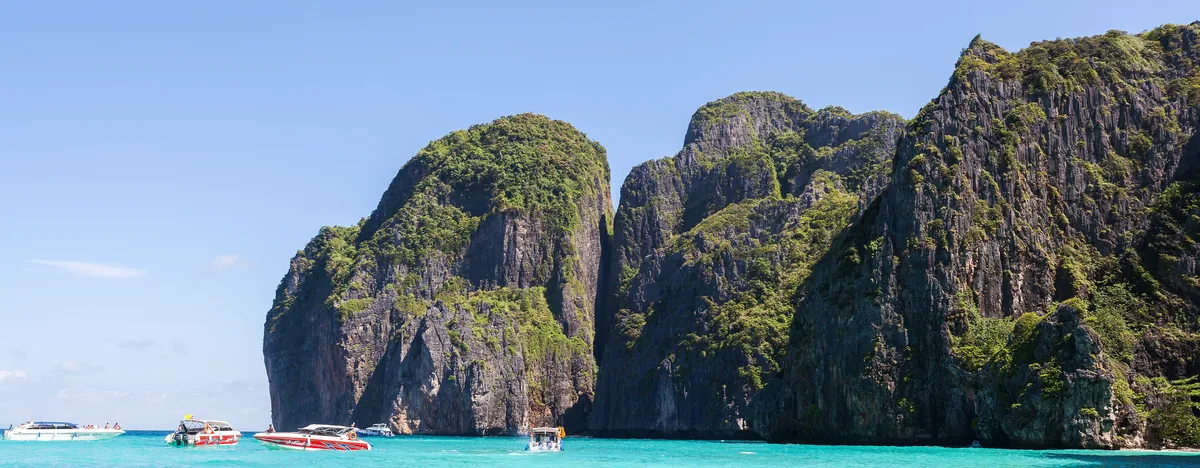
Why headcount caps fail if boat propellers stay in the lagoon
Before Thailand’s Department of National Parks, Wildlife and Plant Conservation (DNP) ordered an indefinite closure of Maya Bay in June 2018, marine surveys estimated that live coral cover inside the 250-meter-wide limestone cove had fallen below 8 percent.1 Popular accounts blamed tourist sunscreen and foot trampling alone, but marine biologists working on the restoration identified mechanical anchor drag, propeller sediment plumes, and bilge discharge from more than 200 speedboats and longtail boats backing onto the beach each day as the primary cause of coral mortality.
During the 43-month closure—originally planned for four months, extended repeatedly, and then prolonged by pandemic border closures through December 2021—marine teams outplanted more than 30,000 coral fragments onto artificial substrates while blacktip reef sharks returned to pup in the shallow bay waters.1
| Management parameter | Pre-June 2018 regime | Post-January 2022 regime |
|---|---|---|
| Daily visitor volume | 5,000–6,000+ in peak season (unscheduled) | Capped at 375 visitors per 1-hour slot (7 a.m.–6 p.m.) |
| Boat access & anchoring | 200+ speedboats/longtails entering & anchoring inside cove | Complete boat ban in Maya Bay; floating pier at Loh Samah Bay + wooden boardwalk |
| Water contact & sunscreen | Unrestricted swimming, snorkeling & reef trampling | Wading no deeper than knee height; swimming banned; reef-toxic sunscreens barred |
| Annual ecological rest | Open 12 months | Closed every August 1–September 30 during southwest monsoon |
Separating visitor sightlines from reef habitat
When Maya Bay reopened on January 1, 2022, DNP retained daily tourism revenue (400 baht foreign national-park admission) while altering the physical path of every visit. Speedboats now moor at a floating pontoon in Loh Samah Bay on the opposite side of the island, and visitors walk across a raised wooden boardwalk to view the beach for up to one hour in batches of 375.2 Swimming remains prohibited; rangers whistle visitors back if they wade past knee depth.
Five seasons into the reopened regime (including annual two-month monsoon closures each August and September), Maya Bay demonstrates that physical zoning often matters more than total headcount reductions. At 375 visitors per hour across eleven daytime slots, Maya Bay can still admit up to 4,125 people on a peak winter day—roughly 70 to 80 percent of pre-2018 daily volume—while reducing reef mechanical disturbance inside the cove toward zero. The remaining bottleneck has simply shifted to mooring-buoy queues at Loh Samah Pier.
Notes and primary sources
- 1
The Guardian, “Thailand’s Maya Bay, location for The Beach, to close to tourists,” February 14, 2018; Department of National Parks, Wildlife and Plant Conservation (Thailand) and marine restoration teams at Kasetsart University / Reef Guardian Thailand, coral outplanting reports 2018–2021.
- 2
Bangkok Post, “Jan 1 reopening of Maya Bay confirmed,” December 19, 2021; Bangkok Post, “Maya Bay is now open to tourists,” January 6, 2022; The Guardian, “Thailand cove made famous in The Beach reopens to visitors after four-year closure,” May 16, 2022.
Cite this publication
Saechueng, Chaiwat, and Mukesh Thakur. 2026. “Four Years Closed, Reopened at 375 an Hour: Coral Recovery and Boat-Free Mooring at Thailand’s Maya Bay.” Meridian Field Dispatch FD 2026-10, June 24, 2026. https://doi.org/10.5281/zenodo.24355869.
@techreport{mtri_fd_2026_10,
  author      = {Saechueng, Chaiwat and Thakur, Mukesh},
  title       = {Four Years Closed, Reopened at 375 an Hour: Coral Recovery and Boat-Free Mooring at Thailand’s Maya Bay},
  institution = {Meridian Tourism Research Institute},
  type        = {Field Dispatch},
  number      = {FD 2026-10},
  address     = {New York, NY},
  year        = {2026},
  month       = {June},
  doi         = {10.5281/zenodo.24355869},
  url         = {https://meridiantourismri.org/articles/maya-bay-closure-reef-recovery-hourly-cap.html}
}