
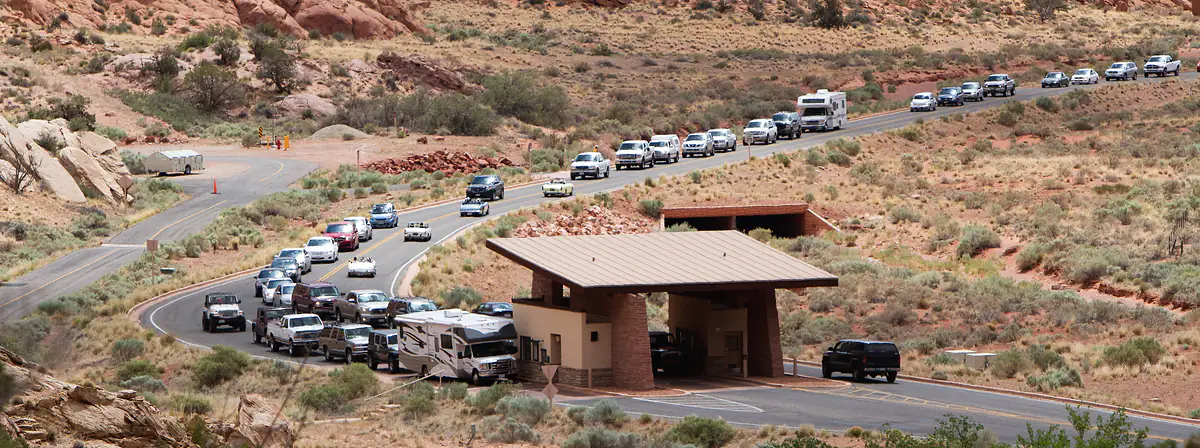
Why Arches is the cleanest natural experiment in the National Park System
Most large national parks have four or five highway entrances, complicating efforts to measure vehicle displacement. Arches National Park outside Moab, Utah has essentially one paved public entrance off U.S. Route 191. In 2021, when post-pandemic road-trip demand pushed Arches to 1.81 million visits, park rangers had to temporarily close the entrance gate more than 100 times—often for three to five hours at mid-day—whenever interior parking lots at Devils Garden and Delicate Arch filled completely.1
Beginning in April 2022, the National Park Service introduced mandatory one-hour timed-entry windows between 7:00 a.m. and 4:00 p.m., booked online via Recreation.gov for a $2 administrative fee. Unplanned mid-day highway gate closures fell to zero during active reservation months, and visitor intercept surveys conducted by Utah State University researchers found over 80 percent satisfaction among visitors who successfully entered the park.1
| Park unit | Regulated corridor or gate | Operating window | Permit design | Observed spillover / political tension |
|---|---|---|---|---|
| Arches NP (Utah) | Entire park (single U.S. 191 entrance) | 7:00 a.m.–4:00 p.m. (peak spring/fall; summer pause tested) | 1-hour arrival blocks ($2 fee) | Moab hoteliers & Grand County debated mid-summer July–Aug exemption |
| Glacier NP (Montana) | West Going-to-the-Sun Rd & North Fork | 7:00 a.m.–3:00 p.m. (mid-June to Sept.) | Switched in 2025 from 1-day pass to 2-hour timed blocks | Heavy pre-7 a.m. entry & unreserved East-side St. Mary afternoon inflows |
| Rocky Mountain NP (Colorado) | Bear Lake Corridor vs. rest of park | 5:00 a.m.–6:00 p.m. (Bear Lake); 9:00 a.m.–2:00 p.m. (rest) | Two-tier corridor + parkwide 2-hour windows | 5 a.m. Bear Lake start prevents the dawn rush seen at 7 a.m. parks |
| Zion NP (Utah) | Angels Landing trailhead (chain section) | All day, year-round | Seasonal & day-before hiker lottery ($6 app + $3/person) | Cuts narrow-ridge crowding without restricting Zion Canyon shuttle access |
Two unintended margins: the 6:15 a.m. rush and BLM public-land spillovers
Hourly traffic-counter loops inside Arches and Glacier reveal a textbook boundary effect. Whenever a timed-entry window begins at 7:00 a.m. (or previously 6:00 a.m. at Glacier), travelers without reservations line up at 5:45 a.m. to 6:45 a.m., shifting the daily peak from 10:30 a.m. into dawn hours and filling trailhead lots before 7:00 a.m. reservation holders even reach the booth. Rocky Mountain National Park solved that boundary spike on its high-demand Bear Lake Road only by pushing the permit start time back to 5:00 a.m.2
Second, turned-away spontaneous travelers do not vanish from eastern Utah. Surrounding Arches are vast Bureau of Land Management (BLM) canyons—Corona Arch, Fisher Towers, Sand Flats—and Dead Horse Point State Park, which carry lighter ranger staffing and fewer vault toilets than NPS units. Gateway business associations in Moab and Kalispell have simultaneously lobbied congressional delegations over reduced walk-in foot traffic from unreserved highway travelers, illustrating that even when a $2 quota raises inside-the-fence visitor welfare, gateway retail towns bear the variance of denied walk-up entries.
Notes and primary sources
- 1
U.S. National Park Service, Arches National Park Timed Entry Pilot Reports (2022–2025); Jordan W. Smith, Monjaellino, and colleagues, Institute of Outdoor Recreation and Tourism, Utah State University, visitor experience evaluations of Arches National Park timed entry.
- 2
U.S. National Park Service, Glacier National Park 2025 Timed Entry Vehicle Reservation Plan (adopting two-hour entry blocks from 7:00 a.m. to 3:00 p.m.) and Rocky Mountain National Park Timed Entry Permit System (5:00 a.m. Bear Lake Road start).
Cite this publication
Saechueng, Chaiwat, and Mukesh Thakur. 2026. “Timed-Entry Reservations in U.S. National Parks: Gate Queues, Early-Morning Displacement, and Gateway-Town Spillovers.” Meridian Field Dispatch FD 2026-09, July 15, 2026. https://doi.org/10.5281/zenodo.24355867.
@techreport{mtri_fd_2026_09,
  author      = {Saechueng, Chaiwat and Thakur, Mukesh},
  title       = {Timed-Entry Reservations in U.S. National Parks: Gate Queues, Early-Morning Displacement, and Gateway-Town Spillovers},
  institution = {Meridian Tourism Research Institute},
  type        = {Field Dispatch},
  number      = {FD 2026-09},
  address     = {New York, NY},
  year        = {2026},
  month       = {July},
  doi         = {10.5281/zenodo.24355867},
  url         = {https://meridiantourismri.org/articles/us-national-parks-timed-entry-arches-glacier-yosemite.html}
}